
下載app免費(fèi)領(lǐng)取會(huì)員





由MVRDV改造的Tripolis辦公園已正式完工,原建筑是荷蘭現(xiàn)代主義代表的著名建筑師Aldo van Eyck晚期的經(jīng)典項(xiàng)目之一。受阿姆斯特丹地產(chǎn)開(kāi)發(fā)商Flow Development委托,MVRDV依據(jù)Van Eyck的原始設(shè)計(jì)修復(fù)了三座歷史建筑中的兩座,并在場(chǎng)地邊緣增加了一座12層高的“伏地大樓”,以保護(hù)原建筑群(包括旁邊同為Van Eyck設(shè)計(jì)的阿姆斯特丹孤兒院)免受來(lái)自A10高速公路的空氣污染和噪音干擾。新建筑與歷史建筑之間以彼此“鑲嵌”的形式結(jié)合,保留了適當(dāng)?shù)拈g隙,衍生出充滿(mǎn)驚喜的空間,并通過(guò)連橋連接,實(shí)現(xiàn)新與舊之間巧妙的融合和對(duì)話(huà)。
The construction of Tripolis Park, which renovates and transforms one of the last projects completed by the celebrated Dutch modernist architect Aldo van Eyck, is complete. On behalf of developer Flow, MVRDV restored two of the three listed heritage buildings in line with Van Eyck’s original designs and added a 12-storey “l(fā)andscraper” along the edge of the site to shelter the complex (which includes Van Eyck’s Amsterdam Orphanage next door) from noise and dust generated by the adjacent A10 highway. The new building is careful in its relationship with the heritage buildings, keeping a respectful distance so that an exciting in-between space emerges where the two meet, with bridges crossing overhead to connect old and new.


Tripolis辦公園最早由三座造型獨(dú)特辦公建筑組成,面積分別為11,000、8,000和6,000平方米,它的建造與Van Eyck的杰作——阿姆斯特丹孤兒院有著千絲萬(wàn)縷的聯(lián)系。孤兒院于1960年竣工,是結(jié)構(gòu)主義運(yùn)動(dòng)最具代表性的項(xiàng)目之一,但到1986 年時(shí)已經(jīng)面臨拆除的威脅。然而一場(chǎng)成功的公眾請(qǐng)?jiān)富顒?dòng)使得孤兒院最終得以保留,之后,阿姆斯特丹市政府將相鄰的土地提供給開(kāi)發(fā)商,前提條件是Aldo和妻子Hannie van Eyck必須在基地內(nèi)設(shè)計(jì)一座新的辦公園。1994年,Tripolis辦公園建成,也因此被當(dāng)做守護(hù)孤兒院的象征。
The creation of Tripolis, a trio of idiosyncratic office buildings of 11,000, 8,000, and 6,000 square metres, was inextricably linked to Van Eyck’s masterpiece, the Amsterdam Orphanage. Completed in 1960, the orphanage was one of the most important projects of the Structuralist movement, yet by 1986 it was already threatened with demolition. A successful international campaign was launched to save the orphanage, and the municipality of Amsterdam offered the adjacent land to the developer – on the condition that Aldo and Hannie van Eyck should design the new office complex. In 1994, their new design was completed, and thus Tripolis began its life as the symbolic saviour of the orphanage.

MVRDV對(duì)Tripolis辦公園的改造無(wú)疑為這段歷史書(shū)寫(xiě)了新的篇章。最初,Aldo設(shè)計(jì)的Tripolis在建成后并沒(méi)有取得預(yù)期的商業(yè)成功,空置多年。再加上當(dāng)時(shí)即將延伸至此處的A10高速公路(包括在Tripolis旁的新入口匝道)可能會(huì)帶來(lái)噪音和灰塵污染。正如1980年代的孤兒院一樣,Tripolis也需要通過(guò)新的干預(yù)帶來(lái)新的活力和價(jià)值。通過(guò)對(duì)歷史檔案的研究,以及與Van Eyck繼承人的密切合作,MVRDV 的改造設(shè)計(jì)不僅對(duì)建筑進(jìn)行了修復(fù),而且進(jìn)一步還原了Van Eyck的設(shè)計(jì)初衷。例如,原設(shè)計(jì)稿中的辦公樓外墻應(yīng)該選用木材覆蓋,而不是1990年代開(kāi)發(fā)商為節(jié)約成本而采用的便宜木材與花崗巖的組合。同時(shí),原建筑的多色窗框也得以保留。
MVRDV’s design makes the next step in this history. The original Tripolis did not prove commercially successful, standing empty for years. Meanwhile an upcoming expansion of the adjacent A10 highway, which includes a new on-ramp right alongside the Tripolis site, threatened to bring increased noise and pollution. Like the orphanage in the 1980s, the Tripolis buildings, in turn, needed an intervention to ensure their future. Following archival research and close collaboration with Van Eyck’s heirs, MVRDV’s design has restored the buildings’ fa?ades not to their original state, but one step better: to Van Eyck’s initial designs. For example, the fa?ades are now fully clad in wood, unlike the cheaper wood and granite combination requested by the Tripolis developer in the 1990s. The building’s multi-coloured window frames are also retained.


在室內(nèi)空間的改造中,MVRDV保留了樓梯和天然石材地板等特色元素,同時(shí)通過(guò)現(xiàn)代化的更新,實(shí)現(xiàn)辦公空間的升級(jí),賦予更加激勵(lì)協(xié)作和開(kāi)放的氛圍。拆除了原有的隔墻,打造通透的空間,并增加了可持續(xù)的設(shè)計(jì)。在屋頂增加了綠化、增設(shè)涼亭,充分利用屋頂空間,為辦公人員提供休息、互動(dòng)和活動(dòng)的場(chǎng)所。同時(shí)安裝了太陽(yáng)能板,項(xiàng)目也因此獲得了BREEAM可持續(xù)建筑評(píng)估體系“杰出(Outstanding)”級(jí)別認(rèn)證。
Inside, the renovation keeps characteristic elements such as the staircases and the natural stone floors, but it also adapts the buildings to bring them in line with modern standards, where offices are increasingly seen as spaces for meeting and collaborating. Dividing walls have been removed, so that the building is less compartmentalised, while various interventions make the building more sustainable. The roofs are now used more intensively, with greenery and pavilions that enable interaction between all users of the complex and which can be used for events. Solar panels are also introduced, helping the development achieve BREEAM Outstanding sustainability certification.

在對(duì)原建筑進(jìn)行翻新之外,MVRDV還在基地邊緣處增加了一座12層高的“伏地大樓”,名為“窗口(The Window)”,緊鄰A10高速公路,形成一道隔離噪音和空氣污染的屏障。這座34,000平方米的辦公大樓采用了網(wǎng)格狀的立面,南面切出了一個(gè)大尺度的矩形窗口,透過(guò)窗口可以看到原有的Tripolis建筑群,保留了項(xiàng)目的歷史記憶。北立面則通過(guò)充滿(mǎn)趣味性的起伏形態(tài)巧妙呼應(yīng)了原Tripolis建筑群的復(fù)雜輪廓。起伏的立面在室內(nèi)順延出巧妙的過(guò)渡空間,隔絕了高速路的噪音,富有趣味性,并通過(guò)連橋?qū)崿F(xiàn)了新舊建筑的連接。
The project isn’t just a renovation, however: a 12-storey landscraper known as “The Window” stands on the edge of the plot, pushed as close as possible to the A10, to form a protective wall between the highway and the rest of the site. A large rectangular window has been cut from the gridded south facade of the 34,000-square-metre office building, offering a view upon the original Tripolis complex to emphasise the project’s heritage aspects. On the other side of the building, the northern facade responds playfully to the Tripolis buildings, indented by an “echo” of their complex shapes. This intervention creates an undulating interior, an exciting, low-noise intermediate space where bridges connect the old and new buildings.


“當(dāng)歷史建筑和舊建筑不再適用時(shí),拆除總是最簡(jiǎn)單的選擇,尤其是當(dāng)它位于高層建筑占主導(dǎo)地位的商業(yè)區(qū)時(shí),”MVRDV創(chuàng)始合伙人Winy Maas說(shuō)道。“Tripolis辦公園的改造提供了一種保護(hù)歷史建筑的特別方法,同時(shí)滿(mǎn)足了當(dāng)下市場(chǎng)對(duì)辦公建筑和空間的需求。它結(jié)合了新的密度,延續(xù)了阿姆斯特丹南區(qū)的發(fā)展進(jìn)程;它也并沒(méi)有單純復(fù)制Van Eyck的初衷,而是創(chuàng)造了新的需求和新的時(shí)間層次。它強(qiáng)調(diào)了‘中間的空間’,正如我還是學(xué)生時(shí)Aldo告訴我的,‘中間的空間’正是建筑之美的主要起源之一。”
“Demolition of heritage is always the easy option, especially if it is located in a business district dominated by high-rise buildings,” says MVRDV founding partner Winy Maas. “Tripolis Park offers an approach to protecting heritage that at the same time meets people’s expectations for an office today. It combines this with new densification, a continuation of the development at Amsterdam Zuidas, that doesn’t copy Van Eyck’s intention, but creates a new one, like a new layer in time. And it celebrates the in-between which, as Aldo explained to me when I was a student, is one of the main sources of beauty in architecture.”


Tripolis辦公園完成改造之后,Van Eyck的經(jīng)典作品又重新回到了辦公地產(chǎn)市場(chǎng),吸引了Uber和荷蘭知名律師事務(wù)所De Brauw Blackstone Westbroek等頭部企業(yè)入駐。未來(lái)幾年,原Tripolis辦公樓的第三棟建筑將繼續(xù)進(jìn)行修復(fù),場(chǎng)地的綠化也將持續(xù)進(jìn)行,人們可以通過(guò)步行或騎自行車(chē)從這里到達(dá)附近的地鐵站和阿姆斯特丹商務(wù)區(qū)的其他目的地,從而形成一個(gè)公園式的辦公園區(qū),Aldo van Eyck在1960年和1994年完成的這兩座建筑經(jīng)典也得到了應(yīng)有的庇護(hù)。
With Tripolis Park, Van Eyck’s monument is re-established within the current office rental market, evident in the fact that it has attracted two prestige tenants in Uber and law firm De Brauw Blackstone Westbroek. In the coming years, work will continue on the third of the original Tripolis buildings. The greening of the site, which will be easily accessible via walking and cycling paths from the other parts of the Zuidas and the nearby metro station, will also continue, forming a park-like campus in which Aldo van Eyck’s buildings – from 1960 and 1994 alike – are sheltered and preserved.

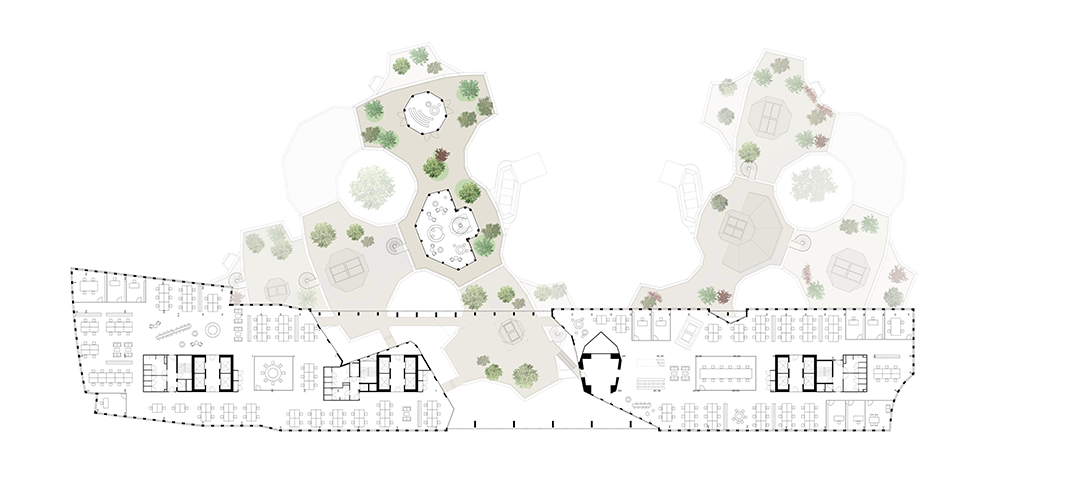
設(shè)計(jì)圖紙 ▽



完整項(xiàng)目信息
Facts
Project Name: Tripolis Park
Location: Amsterdam, The Netherlands
Year: 2018–2023
Client: Flow Development
Size and Programme:61,000㎡ Offices, Public amenities
Sustainability certification:BREEAM-NL-Outstanding
Credits
Architect:MVRDV
Founding Partner in charge:Winy Maas
Director:Gideon Maasland
Associate Design Director:Gijs Rikken
Project Leader:Rik Lambers, Bob de Rijk
Design Team:Steven Anton, Roxana Aron, Guido Boeters, Teodora Cirjan, Joao Viaro Correa,
Guillermo Corella Dekker, Karolina Duda, Cas Esbach, Valentina Fantini, Rico van de Gevel, Piotr
Janus, Nika Koraca, Urszula Kuczma, Claudia Mainardi, Sanne van Manen, Rugile Ropolaite, Irgen
Salianji, Maxime Sauce, Claudia Storelli, Karolina Szóstkiewicz, Laurens Veth, Olesya Vodenicharska,
Mark van Wasbeek, Mariya Badeva, Rebecca Fiorentino, Nefeli Stamatari, Michele Tavola,
Aleksandra Wypiór
Visualisations:Antonio Luca Coco, Luca Piattelli, Kirill Emelianov, Pavlos Ventouris, Francesco Vitale
Copyright:MVRDV Winy Maas, Jacob van Rijs, Nathalie de Vries
Partners
Co-architect:Powered by EGM
Contractor:G&S Bouw
Project coordination:Toussaint Project Management
Landscape architect:Deltavormgroep
Structural engineer:Van Rossum Raadgevende Ingenieurs
Installations consultancy:Arcadis
MEP:Bosman Bedrijven
Cost calculation:BBN
Building Physics & Environmental Advisor:DGMR
Interior architect:Concrete
編輯 / 李翊嫻
視覺(jué) / 饒安林? 校對(duì) / 李翊嫻
本文由MVRDV授權(quán)有方發(fā)布,部分圖片源自網(wǎng)絡(luò),版權(quán)均歸原作者所有。歡迎轉(zhuǎn)發(fā),禁止以有方編輯版本轉(zhuǎn)載。
本文版權(quán)歸腿腿教學(xué)網(wǎng)及原創(chuàng)作者所有,未經(jīng)授權(quán),謝絕轉(zhuǎn)載。

上一篇:行業(yè)新聞 | 西寧城鎮(zhèn)綠色建筑占比躍升
下一篇:裝配式政策 | 佛山市住建局 | 關(guān)于開(kāi)展2024年度智能建造試點(diǎn)項(xiàng)目及龍頭骨干企業(yè)申報(bào)工作的通知


推薦專(zhuān)題














- 同濟(jì)院新作:上海自行車(chē)館,技藝與速度美學(xué)
- 公共空間的輕介入——旋膜廊橋和六角金星
- 舊木料,老工棚,在長(zhǎng)城腳下“長(zhǎng)”出了一個(gè)新故事
- 武漢國(guó)家網(wǎng)安基地軟件園 / Aedas+中信設(shè)計(jì)
- 成都天府興隆湖實(shí)驗(yàn)室二期 / 榮朝暉工作室+杭州心象建筑
- 大慶蘭德湖藝術(shù)中心,品牌“針灸” / 慢珊瑚設(shè)計(jì)
- 華僑城創(chuàng)意園Loft辦公室改造,弧與光 / ARC Z
- line+打造新昌小球中心:SportsMall,從賽事容器到城事發(fā)生器
- 挖地2米破解限高難題?這座“白磚裹黑盒”的劇院,讓公園美景穿墻來(lái)
- 建筑的學(xué)問(wèn),何處安身:四所學(xué)院如何鑄就建筑師?
